

Which handle for a filomuro door: rosette, finish and height
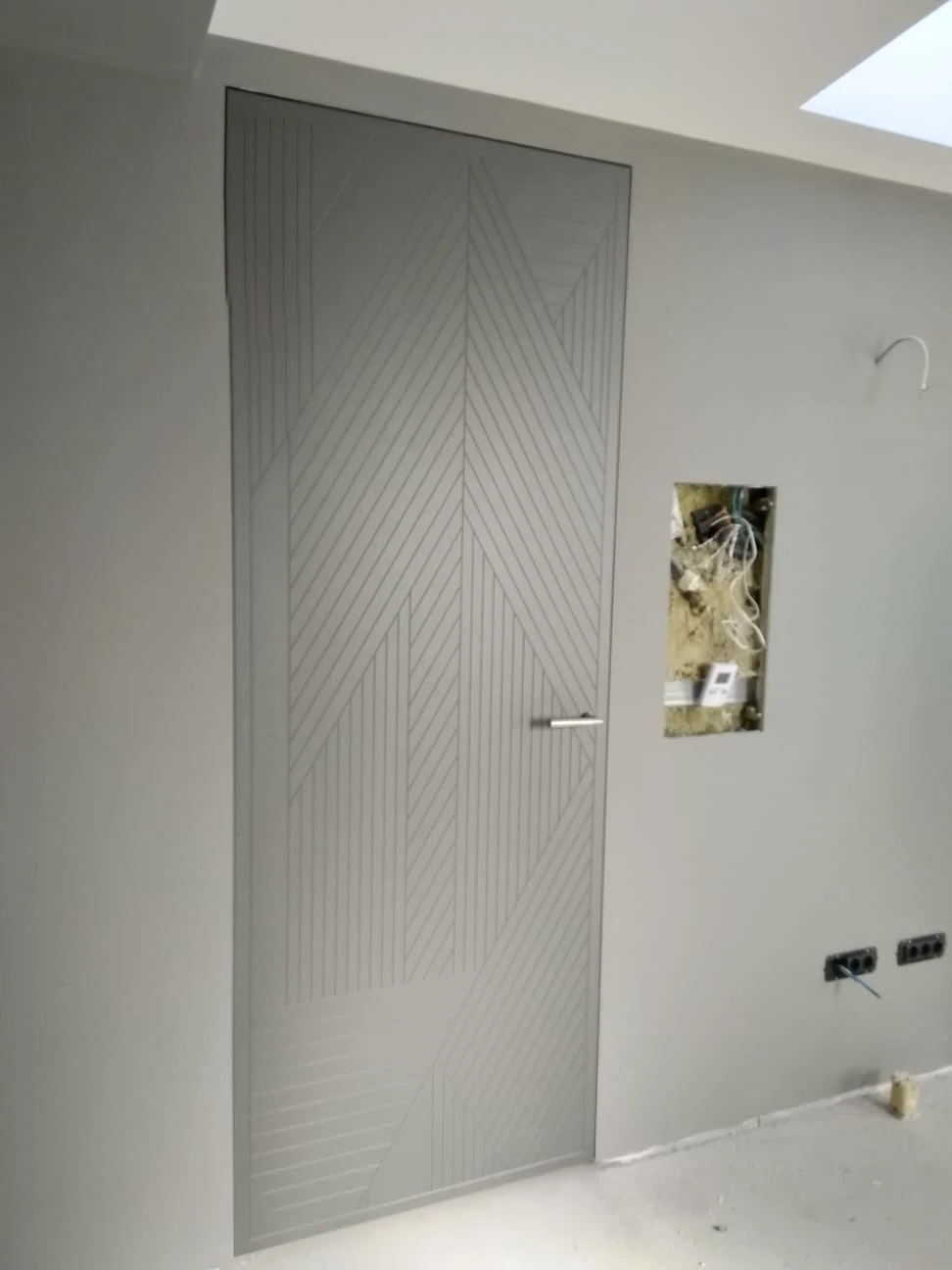
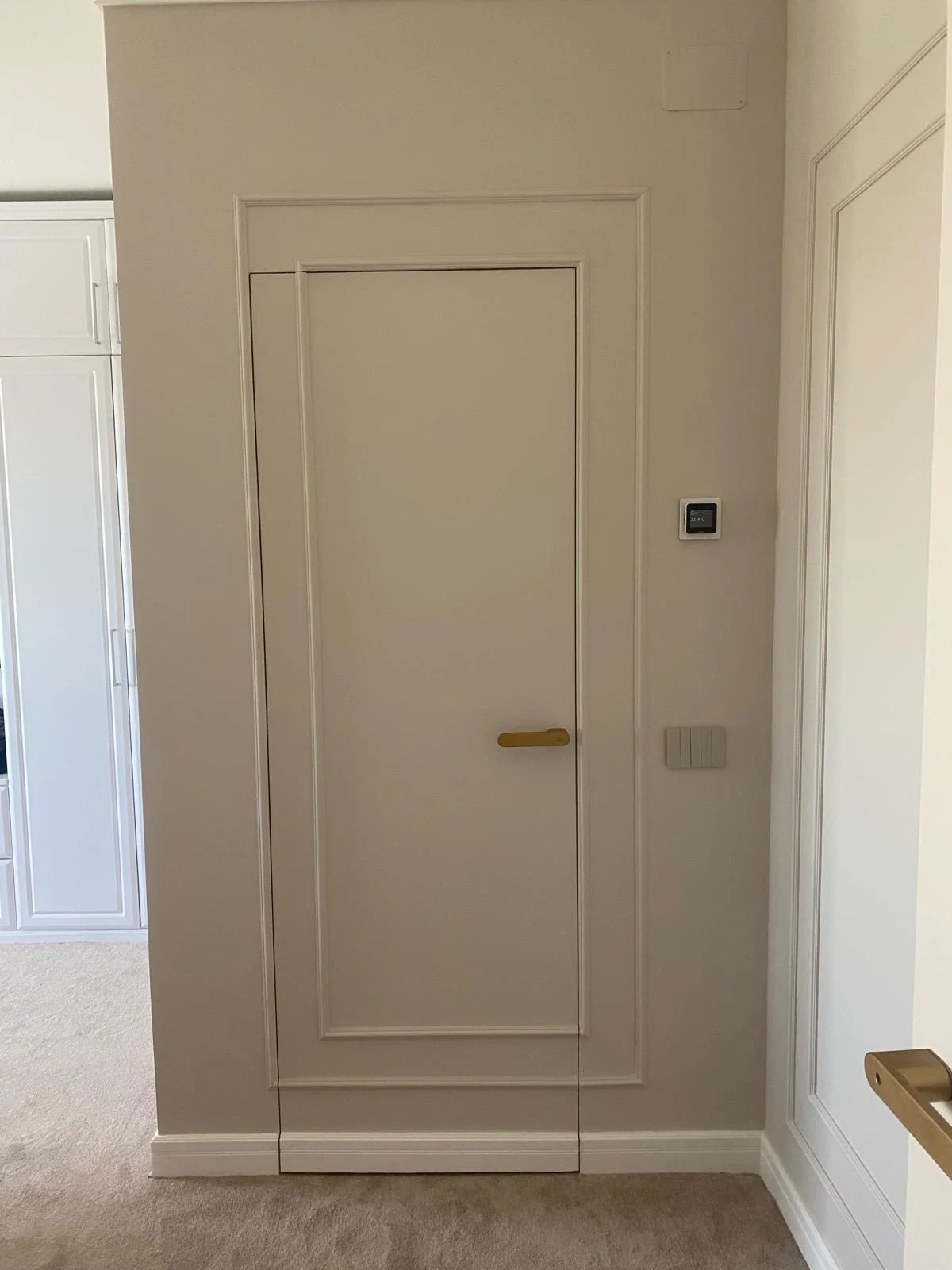
On an invisible door, the handle is the only piece of hardware left in sight. The frame is hidden in the wall, the hinges are concealed in the edge, the gap is 3 mm, and the leaf carries a single piece of metal at hand height. A badly chosen handle, with a thick rosette or a finish that clashes with the wall, cancels exactly the effect you paid for. This guide shows which handle types suit a filomuro door, how to choose the rosette and the finish, at what height the handle is fitted and what has to be decided before the leaf goes into production.
Why the handle is decided before production
On a classic timber door a joiner can rout a new pocket at any time. On a filomuro door the leaf has a perimeter frame of extruded aluminium and a sandwich core, and the lock pocket, the spindle hole and any rosette holes are machined on a CNC in the factory. The handle type fixes three things that go into the order: the distance from the edge to the handle axis, how the rosette is fastened and which side the handle sits on. All three depend on the lock you choose, because handle, lock and strike plate form one system.
Interior handles use an 8 mm spindle, and handles with no visible screws clip onto a base rosette that is screwed into the leaf. The aluminium frame holds screws far better than an MDF leaf, but it does not allow improvised holes on site without weakening the seal of the leaf. The right decision is therefore to choose the handle together with the door, not after it has been installed.
Handle types compatible with a filomuro door
On a flat leaf with no frames and no mouldings, anything you add becomes visible. The comparison below looks at the handle from the point of view of what stays on the leaf, not just the mechanism.
| Handle type | What stays visible on the leaf | Rosette thickness | Where it fits | Indicative cost |
|---|---|---|---|---|
| Lever on standard rosette | Lever + round or square rosette of 50-53 mm | 7-10 mm | Standard doors, tight budgets | Included in the offer |
| Lever on long backplate | Lever + 200-250 mm plate with cylinder hole | 8-12 mm | Classic keyed doors; not recommended on filomuro | 150-400 RON/set |
| Slim vertical pull (bar) | Discreet bar, recessed or surface-mounted | no rosette | Office doors, dressing rooms, heavy traffic | +150-300 RON |
| Push or magnetic closing, no handle | Nothing | no rosette | Storerooms, dressing rooms, secondary doors | Included or +100-250 RON |
| Lever on slim rosette or with no visible rosette | Lever only, 2-3 mm rosette or rosette recessed in the leaf | 2-3 mm or 0 mm | Any filomuro door, living room, bedroom, bathroom | 250-600 RON/set |
- The standard rosette works, but it stands 7-10 mm proud of the leaf and adds a visible disc to a surface that should read as continuous. On a filomuro door it is the most common compromise and the easiest to avoid.
- The long backplate only makes sense on doors with a security cylinder. On an interior door with a magnetic lock there is nothing to cover, and the 200 mm plate becomes the dominant element of the leaf.
- The slim vertical pull keeps the pulling gesture without a lever. It is the option for doors opened dozens of times a day, where a push system gives no clear grip point.
- Handleless systems are explained separately in the guide to the handleless filomuro door. They remain the cleanest solution, but not for every room.
- The slim or recessed rosette is the recommendation for most filomuro doors: the lever appears to come straight out of the leaf, while the fixing stays mechanical, on a base rosette screwed into the aluminium frame.
Lever shape: straight, L or U
The shape of the lever matters as much as the rosette. A straight lever with a 19-22 mm section and a length of 125-140 mm is the closest to the language of an invisible door: one horizontal line, no scrolls, no ornamental return. The L shape, with the elbow towards the leaf, reads as a single line and suits doors painted tone on tone. The U shape, with the end turned back towards the leaf, has a practical advantage: it does not catch sleeves, bag straps or pockets, which is why it is preferred in narrow corridors and on children's bedroom doors.
The distance between lever and leaf should be 35-40 mm, enough for the fingers without the handle appearing to float away from the door. A lever with a return spring in the rosette stays horizontal after years of use; without a spring, the return depends on the lock alone and the lever may end up slightly drooped. For heavily used doors it is worth checking the durability grade under EN 1906, with 100,000-200,000 tested cycles.
Finish: black, stainless, brass or tone on tone
The handle finish is chosen against the wall and the leaf, not from the catalogue. On a factory-painted Signature door the RAL colour is known in advance, so the handle can be chosen as an accent or as an extension of the leaf. On a Minimal door painted on site, the handle is fitted after the last coat of paint, and its finish has to work with the final wall colour, which you often do not know when you place the order.
| Finish | Leaf colours it works with | Fingerprints and wear | Care | Visual effect |
|---|---|---|---|---|
| Satin stainless steel | White, grey, cool tones | Fingerprints barely visible, fine scratches over time | Damp cloth, no abrasives | Neutral, technical |
| Brushed brass or gold | Cream, beige, dark green, blue | Lacquer may dull in 5-8 years under heavy use | No acidic products | Warm, decorative accent |
| Matt white | White leaf in RAL 9010 or 9016 | Soiling shows on the grip area | Frequent cleaning | Disappears into the leaf |
| Bronze or graphite | Dark grey, brown, veneer | Hides wear well | Damp cloth | Discreet, warm |
| Matt black | Any light colour or RAL 9005 | Fingerprints barely show, scratches appear on weak powder coats | Damp cloth, no solvents | Graphic line on the leaf, the most requested |
Matt black has dominated orders in recent years because it works like a line drawn on a white or grey leaf. Brushed brass has returned together with warm palettes and doors painted in dark green or blue. If you have already chosen the RAL colour for the leaf, the simple rule is: tone-on-tone handle for a door that should disappear, contrasting handle for a door that should be seen as an object.
At what height and on which side the handle is fitted
The handle axis sits 100-105 cm above the finished floor, and at Kulttur the default position of the lock pocket follows this range. The height does not change on floor-to-ceiling doors: a 270 cm door with the handle at mid-height would put the lever at 135 cm, awkward for anyone. The handle stays at hand height and the tall leaf reads as wall, not as a door with a centred handle.
The side the handle sits on follows from the opening direction, and the direction is decided at order stage, because hinges and lock are machined on opposite edges. If the door sits close to a corner, the handle side needs room for the hand: a 130 mm lever plus fingers means at least 150 mm clear between the door edge and the perpendicular wall. For children's rooms, the 100-105 cm height keeps the lever above the reach of a 1-2 year old, a detail explained in the guide to filomuro doors and child safety.
The handle on Minimal and on Signature
On the Minimal model, delivered primed for painting on site, the handle is fitted last, once the paint has fully dried, usually 48-72 hours after the final coat. If the handle is fitted earlier, the painter works around the rosette and removing it later leaves an unpainted outline. The correct sequence is a leaf painted without hardware, with handle and rosette fitted at handover, with the leaf protected.
On the Signature model, factory-painted in a RAL colour, the handle can be delivered with the door and fitted by the installation team on the same day. The advantage is that the rosette is fixed onto an industrially finished surface, powder or oven-cured lacquer, far more resistant to the rosette turning than a roller-applied emulsion. On Signature, a recessed rosette can only be made in the factory, because the machining has to happen before painting.
Common mistakes when choosing the handle
- Handle bought after installation with a different edge-to-axis distance than the one machined in the leaf: the lever does not fit the spindle or the rosette does not cover the pocket.
- Thick rosette on a door painted tone on tone: the 10 mm disc casts a shadow on the leaf and cancels the continuous-wall effect.
- Long backplate with a cylinder hole on a door with a magnetic lock: the hole stays empty or gets a blanking cap.
- Finish chosen from the catalogue without a sample: the polished gold in a photo turns yellow next to a cream wall. Ask for a physical sample and hold it against the leaf in the room's light.
- Different handles on adjacent doors: on a corridor with three filomuro doors, same model and same finish; small differences show more on identical doors.
- Over-tightening the rosette during fitting, which deforms the leaf or cracks the paint around the hole. Screws are tightened to contact, not with a power driver at maximum torque.
At what height is the handle fitted on a filomuro door?
The handle axis sits 100-105 cm above the finished floor, whatever the door height. On a floor-to-ceiling door the handle stays at hand height, not at mid-leaf. The position of the lock pocket is set at order stage and machined in the factory.
Can I change the handle after installation?
Yes, if the new handle has the same 8 mm spindle, the same edge-to-axis distance and a rosette that covers the existing holes. Switching from a rosette to a handle with no visible rosette, or to a long backplate, cannot be done cleanly on site, because the machining of the leaf is only done in the factory.
Is the handle included in the price of a filomuro door?
At Kulttur the standard offer includes a lever on a rosette compatible with the magnetic lock. Design models with a slim rosette, a recessed rosette or special finishes are quoted separately, in the range of 250-600 RON per set, and the slim vertical pull adds 150-300 RON.
Which rosette suits an invisible door?
A slim rosette of 2-3 mm, or a rosette recessed into the leaf. Both leave only the lever visible, while the fixing stays mechanical, on a base rosette screwed into the aluminium frame. The standard 7-10 mm rosette works, but it stands proud of the leaf plane.
Can I choose the handle on the side opposite the hinges?
The handle always sits on the side opposite the hinges, and that side is decided together with the opening direction. Changing the side after production means a new leaf, because the lock pocket and the hinges are machined on different edges.
If you want to see a slim rosette next to a standard one on the same leaf, the showroom at Bulevardul Dacia 153-155 in Bucharest has filomuro doors fitted with several handle types and finish samples you can hold against the leaf. You can also start from the online configurator, where you choose the model, the colour and the handle type, and the quote comes with all hardware details included.
Configure your Filomuro door
Pick the dimensions, finish and see the exact price instantly.
Open configurator